
A Journey from Control to Compassion
For many years, whenever someone I loved was struggling or caught in conflict, my first instinct was to help. I wanted to explain, guide, correct, and make things better. It came from love. I wanted those I cared about to be happy. I wanted them to avoid pain and suffering.
But slowly, through observing my own mind, I began to notice something deeper. Behind the wish to help was also fear. Fear of what might happen. Fear that things would become worse. Fear that if I did not step in, the people I loved would continue to suffer. Without realizing it, I was carrying a responsibility that was not completely mine.
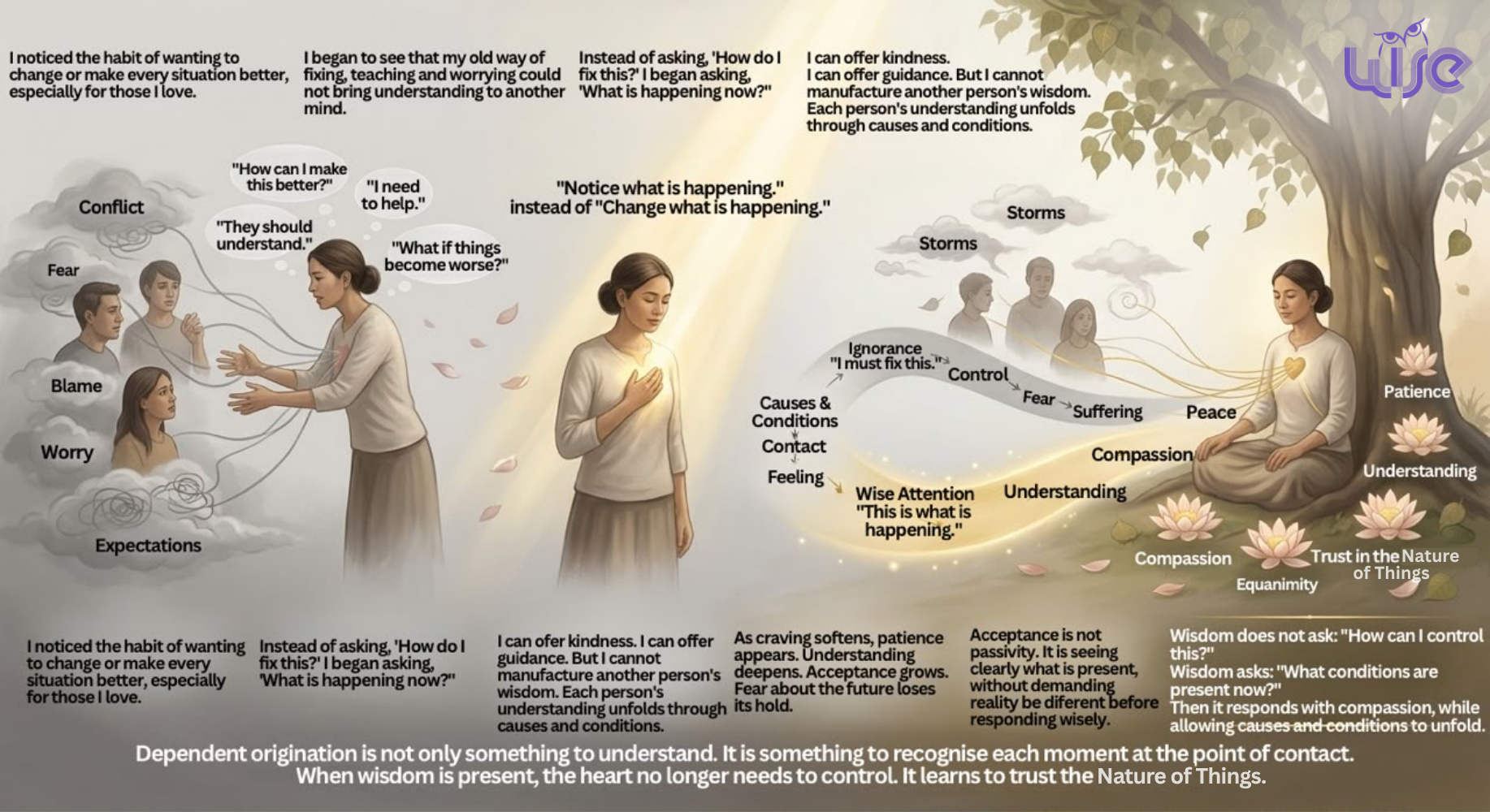
The mind had a familiar pattern: “How can I fix this?” “How can I make them understand?” “What can I do to prevent future suffering?” At that time, I thought this was love. But I began to see that love mixed with fear can become a burden. The heart wants to protect, but the mind starts trying to control what cannot be controlled.
Through understanding dependent origination, I began to see this process more clearly. The suffering was not only in the external situation. The chain was also unfolding within my own mind. Something happened. There was contact. A feeling arose. Then, influenced by old habits and fear, the mind created more: “This should not happen.” “They should change.” “I must do something.” “What if the future becomes worse?”
From there came worry, frustration, attachment and suffering. I was not only responding to what was happening. I was also responding to my own conditioning.
Along this journey, I also began to see another layer within myself—the wish to be recognized, understood and accepted. There was a subtle longing to feel that my efforts were valued, that my intentions were seen, and that my way of helping was appreciated. This too was a form of attachment that quietly created suffering.
Through listening deeply to the wise, attending discourse classes, reflecting on the teachings, and having meaningful conversations that helped me examine the workings of the mind, there was a gradual maturing of understanding. I began to see how the mind creates its own burdens through craving and expectations.
The less the craving, the lighter the burden became.
The less the need to be seen, the more freedom appeared.
The less the demand for things and people to be a certain way, the more space there was for peace, patience and compassion.
With more awareness, a space began to appear. Instead of immediately trying to change the situation, I learned to pause. I began asking: “What is happening here now?” “Can I see this clearly?” “What conditions are present?” This was a different way of relating to life—not through control, but through understanding.
I slowly came to understand that every person is also living through their own causes and conditions. Their thoughts, emotions, habits and choices have their own history. I can offer kindness. I can offer support. I can share wisdom when the conditions are right. But I cannot create another person’s understanding. Wisdom cannot be forced. It arises when the causes and conditions come together.
This understanding has changed the way I love. I am learning that love does not mean carrying another person’s entire journey. Love does not mean taking responsibility for another person’s awakening. Love means being present with compassion while respecting the unfolding of their own path.
Acceptance does not mean giving up. It does not mean becoming uncaring. Acceptance means seeing clearly what is happening without fighting reality first. From that clarity, the right response can arise. Sometimes it is speaking. Sometimes it is listening. Sometimes it is offering help. Sometimes it is simply allowing things to unfold.
When I read and reflected on this understanding deeply, tears came. They were not tears of sadness. Perhaps they were tears of relief. A part of me was finally recognizing: “I have been carrying something for a long time.” “I can love them without carrying their suffering.” “I can care without needing to control.” “I can trust the nature of things.”
The tears were also a meeting between two parts of myself. The old habit said: “I must save them. I must make sure everything turns out well.” The wisdom growing inside said: “I love them. I will do what I can. But I trust causes and conditions.”
The heart was not becoming less loving. It was becoming less afraid.
The situations around me may not always change according to my wishes. The people I love may still experience difficulties. But something within me has changed. There is more patience. More understanding. More acceptance. The fear of the future has become lighter. The mind is more open to causes and conditions. There is a deeper trust in the nature of things.
I am also beginning to understand something that cannot be fully grasped through the five senses alone. There are truths that are discovered not by possessing, controlling or proving, but by seeing clearly through wisdom. The more the mind lets go of what it wants to hold onto, the more it discovers a deeper freedom.
This journey has brought a sense of gratitude—not because everything unfolds according to my wishes, but because each experience becomes a condition for learning and awakening.
I am learning that wisdom does not ask, “How can I control this?” Wisdom asks, “What conditions are present now?” And from that understanding, compassion responds—not from fear, not from attachment, but from clarity.
Dependent origination is not only a teaching to understand. It is something to recognize in each moment. At the point of contact, the mind has a choice. With ignorance, the chain continues. With wisdom, the chain loses its power.
The world does not have to change first for peace to arise. Peace begins when we understand how the mind is relating to the world now.
Perhaps the deepest lesson is this:
I can love without holding on.
I can care without controlling.
I can be present without carrying what belongs to another.
Nothing truly belongs to us, yet everything becomes part of our journey of awakening. Every encounter, every challenge, every joy and every difficulty can become a condition for wisdom to arise when the causes and conditions are ready.
With gratitude, I honour this unfolding journey of discovery.
May others also embark on this beautiful path of seeing, understanding and awakening—discovering through the transcendent wisdom teachings that freedom does not come from holding on, but from seeing clearly, letting go, and allowing wisdom to unfold.
In grace
Chee Guit Yeng
8 September 2026