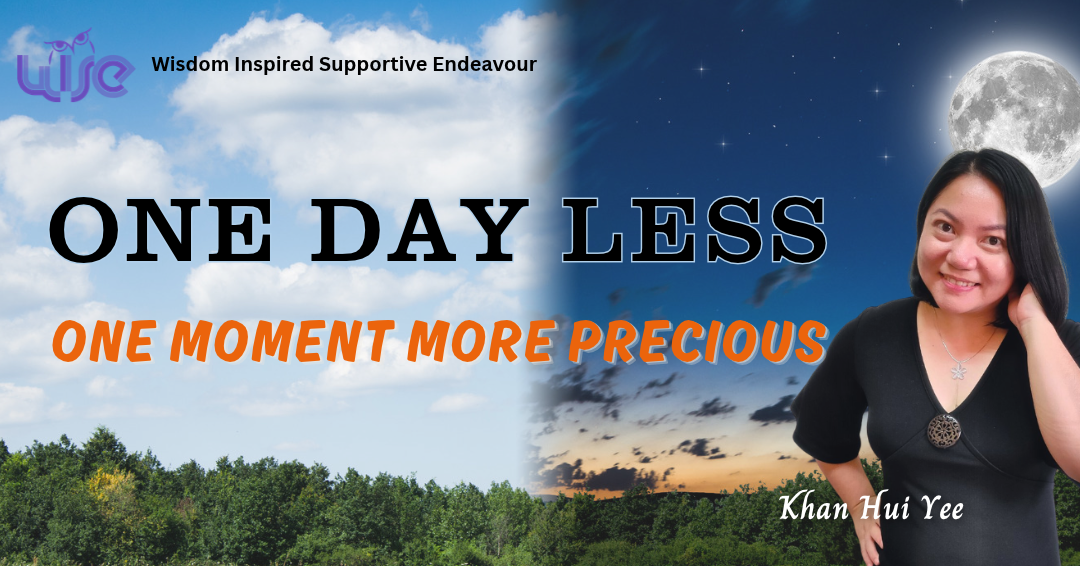
There is a saying, "When we realise each new day is not one day more but one day less, this moment becomes infinitely precious."
We often live as though time is something we own. We make plans, postpone what matters and assume there will always be another opportunity — hours, days, weeks, months or years ahead. But time has never promised us that. We sometimes even speak of time being stolen from us, as though we were entitled to a certain amount of it. It is almost as if, upon birth, we were given a guaranteed life expectancy. But was there ever such a guarantee? Have we ever stopped to question what determines how long we live?
Perhaps we need to look at birth differently. Rather than seeing our birthdays as the beginning of another year ahead, we could also recognise that another year has passed. Each day we wake up is not a day added to what we own, but another day given to us before life comes to an end. Every moment that arises is already passing away. There is a difference between receiving something with appreciation and expecting something because we believe it belongs to us.
Nothing continues simply because we expect it to. Life unfolds through causes and conditions, many of which are beyond our control. We can influence some of these conditions through our actions, but we cannot command the outcomes or guarantee that anything will remain as it is. Recognising this does not mean living in fear or becoming passive about life. On the contrary, it invites us to stop taking what is here for granted and to relate to life with greater understanding.
I once learned from a wise teacher that when we know how we want to die, we will know how to live. It is an invitation to inquire into what is truly important and what is necessary for us to be involved in while we are alive. If we know that we may fear having regrets near the end of life, then perhaps we ought to ask ourselves how we should live today. There are two fundamental kinds of regret: not having done what should have been done, and having done what should not have been done. Yet, this fear of regret can ironically haunt the living, making us behave as though we are already dead — holding back, worrying and becoming preoccupied with what might happen, rather than understanding what is happening now.
If we know what truly matters, why wait until the end of life to live accordingly? If we wish to cultivate kindness, why postpone it? If we wish to live with greater understanding, why wait for a more suitable time to begin? Every new moment offers an opportunity to examine our intentions, actions and the way we relate to our experiences.
We cannot hold on to a moment or make it last a little longer, but we can learn to understand what is happening while it is here. With birth comes the continuous arising and passing away of experiences. Yet, because we do not recognise this, we keep searching elsewhere for something that is already unfolding right before us. We repeat familiar patterns, often without realising that we are doing so. We react, judge, resist and distract ourselves, missing the opportunity to understand what is happening within us.
This is where meditation becomes relevant to our everyday lives. It is not merely about setting aside time to sit quietly, nor is it about trying to create a particular state of mind. It is about learning to acknowledge every happening as nature at work, with the right attitude, and becoming fully aware of it. Whether an experience is pleasant, unpleasant or seemingly insignificant, each offers an opportunity to observe how the mind responds, what it clings to, what it resists and what it creates. The more consistently we develop this awareness, the more we begin to understand the nature of our experiences rather than being blindly carried away by them.
Perhaps the wisest use of time is not to find ways to have more of it, but to understand what is happening with the time we are given. The past has passed, and the future has yet to arrive. Yet our minds spend so much time dwelling in one or the other that we often miss what is happening right now. We tell ourselves stories about what has been and what might be, sometimes forgetting that these too are experiences arising in the present.
We cannot determine how many more days we will have, nor can we guarantee what each day will bring. But we can learn to recognise what is happening, understand how our minds relate to it, and live with greater awareness. Perhaps this is what it means to know how we want to die: not to wait until the end to discover how we should have lived, but to begin living with that understanding now.
Another day has been given. What will we understand from it?
Another year wiser,
Khan Hui Yee
17 November 2026