
Think, Feel, Do
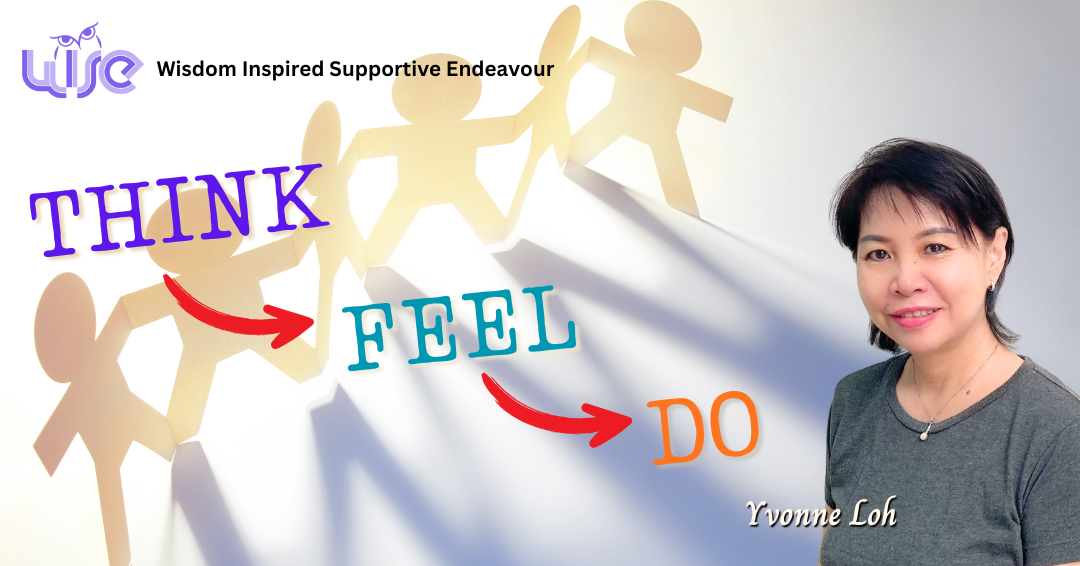
In the corporate world, motivational trainers often remind us of the cycle: THINK → FEEL → DO.
We are taught to be careful of our thoughts because they influence our emotions, and emotions, in turn, shape our actions. This understanding is practical. It helps us function better, build relationships, and navigate daily life with greater ease.
Yet, from the perspective of mental cultivation, the meaning of “Think, Feel, Do” reaches far beyond personal success or social harmony. It is not merely about me or you, surviving and improving in the world. When seen deeply, “Think, Feel, Do” reflects fundamental processes of mind and body—impersonal, conditioned, and ever-changing.
When we remove the identification with self, the cycle of thinking, feeling, and doing is no longer about an individual identity. Instead, it is recognized as the natural interplay of mental and bodily functions: the mind thinks, feelings arise, and then actions follow.
THINK – points to the arising of mind processes, conditioned by past experiences and karmic imprints.
FEEL – connects with the aggregates of perception, sensation, and mental formations, revealing how the mind interprets and reacts.
DO – manifests as bodily or verbal action, the culmination of conditioned causes and effects.
Therefore, Think, Feel, Do is not a personal story but the unfolding of conditioned phenomena.
Through understanding it this way, then these are not “my” thoughts, “my” feelings, or “my” actions—they are just processes unfolding, just nature happening.
Thus non-doing is possible, as it allows us to refrain. When we become aware of thinking and feeling, it creates space before the impulse to do. This space is powerful. We are given to choose wisely, instead of reacting blindly. Sometimes the best choice is not to act at all—to let the thought or feeling pass without feeding it.
Being able to see this truth is, in essence, learning detachment from the five aggregates of clinging, which is the conditionality of our existence. Attachment is an ‘auto mode’, as I call it - and it’s only through this Path and its practice that we can transcend ‘wrong’ thoughts and deeply ingrained habits that will lead to repeated cycles of birth and death.
In retrospect, the words ‘Think, Feel, Do’ may not be taken only as a merely mundane, motivational slogan. There is depth. It simplifies the meaning of ‘mind bodily processes’ as how it could be understood, especially for those who are still early in the practice, and Right Information is still crucial to deepening understanding.
There’s much to learn – feel free to incorporate our practice into everyday life, and vice versa.
Be aware. Be patient. Be persistent. Be consistent. Be vigilant.
Only love,
Yvonne Loh
2 December 2025